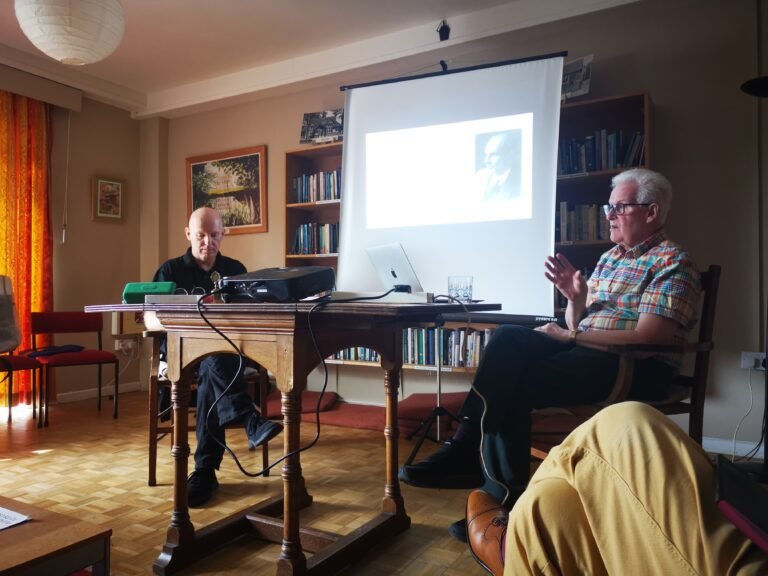
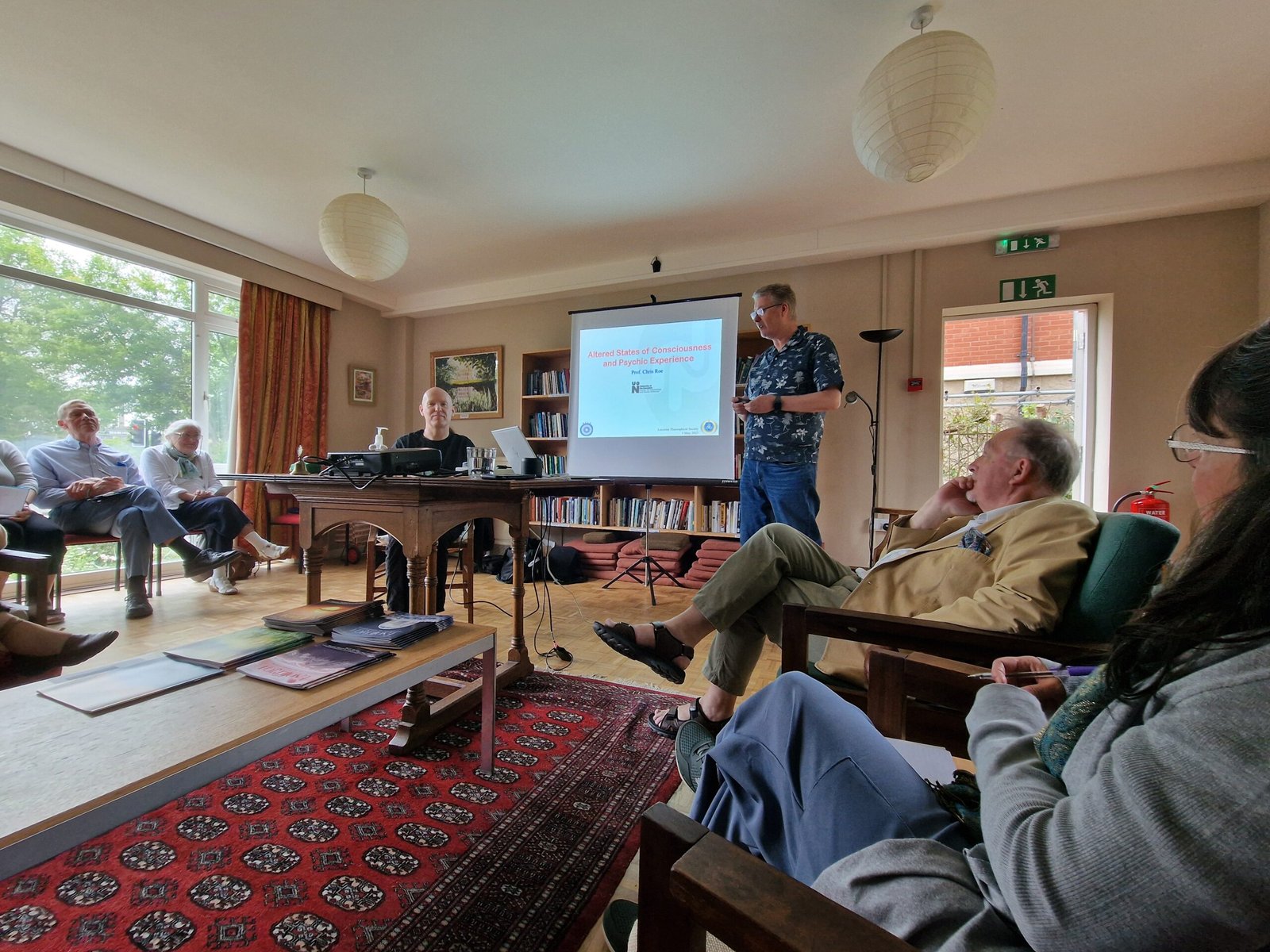
Dreams, ESP, and the meaning of Parapsychology
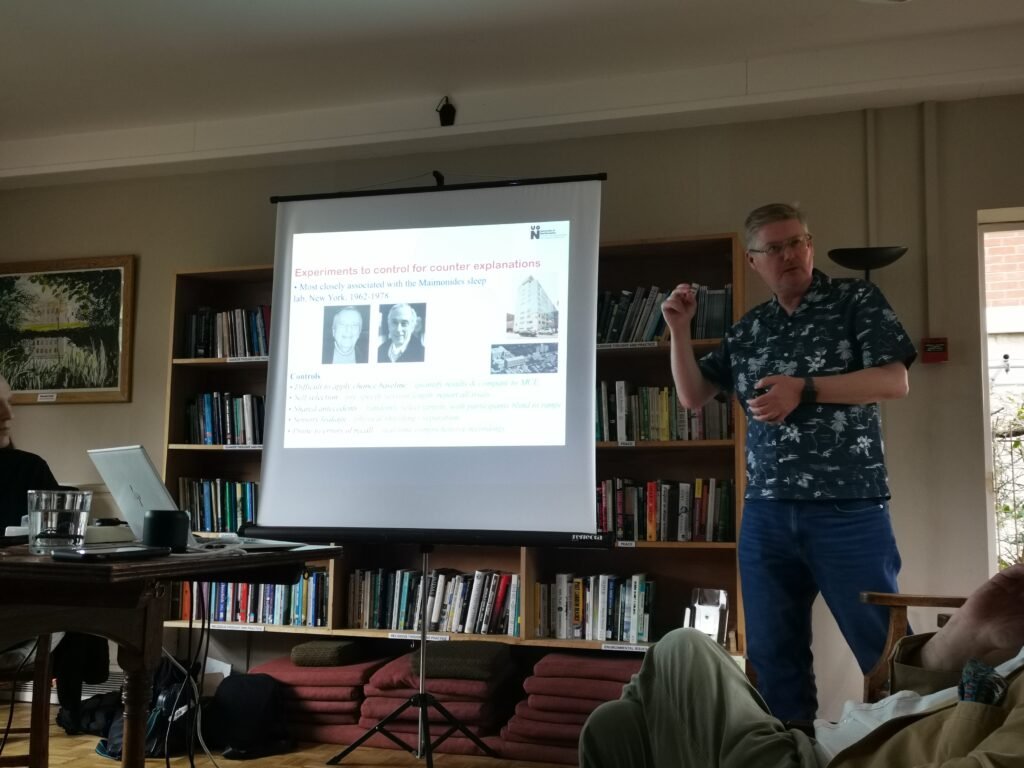
A lively discussion with Professor Chris Roe who heads up the Parapsychology department at the University of Northampton
If you walked into Chris Roe’s talk expecting spoon-bending, crystal balls, and dramatic declarations about the afterlife, you would’ve been gently disappointed — and then pleasantly surprised. What we actually got was something far more interesting: a thoughtful, funny, occasionally unsettling exploration of why people have psychic-type experiences, and how psychologists try (and often struggle) to study them properly.
This wasn’t about proving that we’re all psychic superheroes. It was about taking people’s experiences seriously without losing our critical thinking. And that balance turned out to be the real theme of the evening.
Starting from experience, not belief
One of the first things Chris made very clear is that parapsychology isn’t about believing in the paranormal at all costs. Quite the opposite, in fact. The starting point is simple: millions of people report experiences that feel impossible according to standard scientific explanations. Dreams that seem to predict the future. Strong feelings that something terrible has happened to a loved one — and then finding out it has. Moments where time feels oddly scrambled.
You don’t have to believe these experiences are “psychic” to agree that they happen — and that they can be deeply meaningful, confusing, or even distressing for the people who have them.
Psi: a placeholder, not an answer
Rather than jumping to conclusions, parapsychologists use the term psi as a kind of intellectual shrug. It doesn’t explain anything — it just marks the fact that something odd seems to be going on. Psi covers things like telepathy, clairvoyance, precognition, and psychokinesis, but it’s not a theory. It’s a question mark.
That openness is key. If a psychological explanation works, great. If not, then maybe we need better theories.
Why dreams keep stealing the spotlight
A recurring theme of the talk was how often these experiences happen in altered states of consciousness — especially dreams. Case collections going back nearly a century show the same pattern again and again: people are far more likely to report ESP-like experiences when they’re dreaming, half-asleep, daydreaming, meditating, or just mentally drifting.
These aren’t random, forgettable dreams either. People often say they felt different. More vivid. More urgent. More emotionally charged. That sense of “this matters” is part of what makes them so compelling — and so hard to dismiss as coincidence.
Coincidence isn’t as simple as it sounds
Sceptics often point out that with millions of people dreaming every night, someone is bound to have a dream that comes true. And statistically, that’s absolutely correct.
But Chris highlighted why that explanation doesn’t always feel satisfying. People don’t react this way to every dream. They don’t ring the authorities every time they dream about something trivial. When someone does act — when they feel compelled, disturbed, or shaken — that emotional intensity is part of the phenomenon that needs explaining.
Famous disasters and uncomfortable questions
Some of the most haunting material came from discussions of major tragedies, like the Aberfan disaster. After the event, researchers collected accounts from people who believed they had dreamt about it beforehand — including one mother whose dream chillingly mirrored how the children were later buried.
Are these genuine premonitions? Coincidences shaped by hindsight? Memory distortions? Chris didn’t give neat answers — and that was the point. These cases sit right on the edge of what science can comfortably handle.
Bringing dreams into the lab (without ruining them)
To deal with all the messiness of real life, researchers like Montague Ullman and Stanley Krippner developed dream-ESP experiments in controlled lab settings. Using sleep labs, random targets, strict blinding, and careful timing, they tried to remove things like selective memory, sensory leakage, and biased interpretation.
Chris walked us through how these experiments worked — and how even then, interpretation remains tricky. Humans are incredibly good at spotting patterns, especially when we want to see them.
When researchers become their own guinea pigs
One of the most engaging parts of the evening was when Chris shared his own dream-ESP trials, including some impressively close matches — and some that felt convincing until you looked at them carefully.
These examples were refreshingly honest. They showed just how easy it is to convince yourself after the fact… and how important it is to be cautious, even when the experience feels powerful.
Why case collections still matter
Despite all the problems, Chris made a strong case for revisiting old collections of letters and personal accounts — like those gathered by Louisa Rhine, Alister Hardy, and J.B. Priestley. These aren’t lab experiments. They’re messy, emotional, subjective — and incredibly rich.
If we want experiments that reflect real experiences, we first need to understand how those experiences actually show up in people’s lives.
Psychology with humility
Underlying the whole talk was a kind of quiet humility. Parapsychology, at its best, isn’t about grand claims. It’s about saying: we don’t know yet. About respecting people’s stories while recognising how unreliable memory, perception, and interpretation can be.
Or, as one memorable metaphor put it: if you want to study a rabbit, you first need to know how rabbits behave in the wild.
Leaving with more questions than answers
By the end of the evening, nobody was being asked to believe in psychic powers. But it was very hard to walk away thinking the whole topic is nonsense. What Chris Roe offered wasn’t certainty — it was permission to be curious.
And in a world that often demands instant answers, that felt oddly refreshing.
What is RSPK – recurrent spontaneous psychokinesis?
“The standard explanation in parapsychology for poltergeist phenomena is that they are examples of what’s called RSPK, so recurrent spontaneous psychokinesis.
They actually reflect the fact that the living person in that household, who in some way has pent-up emotional frustration, that needs some form of expression, and the way that manifests itself is physically, in terms of these physical phenomena, objects moving, being thrown around, noises, and so on. That’s the kind of standard explanation that’s our starting point in doing that kind of research at the moment, rather than the literal term poltergeist, which means noisy spirit in German. We don’t tend to think of it as an independent agent, so on.”